


 2026-07-10
 536
536


Rain stops matches. Wind disrupts serves. UV rays damage courts and cause heat exhaustion. For tennis club owners, resort developers, and sports facility managers, these aren’t minor inconveniences—they’re lost revenue, reduced court utilization, and diminished playing experiences.
Until recently, the only solution was an expensive permanent building—months of construction, deep foundations, and a price tag that could run into the hundreds of thousands of dollars per court.
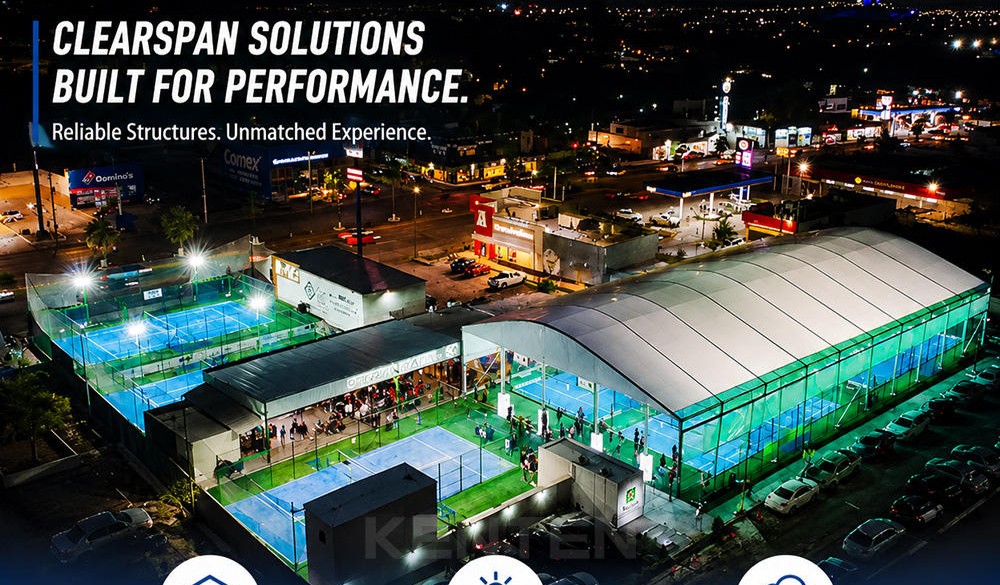
KENTEN, China’s leading aluminum structure tent manufacturer since 2001, offers a smarter way. Our tennis court tent structures combine the strength of aircraft-grade aluminum alloy with advanced architectural membrane technology—delivering all-weather tennis coverage at a fraction of the cost and timeframe of traditional construction.
A tennis ball travels at speeds exceeding 200 km/h during a professional serve. Sun glare, crosswinds, and rain all dramatically affect ball trajectory, bounce consistency, and player safety. A covered tennis court eliminates:
Covered tennis courts generate significantly higher returns than uncovered ones:
| Metric | Uncovered Court | Covered Court |
|---|---|---|
| Playable days/year | 180–250 (weather-dependent) | 350–365 |
| Peak-hour utilization | 60–70% | 85–95% |
| Seasonal revenue dip | 30–50% (winter/rainy season) | Minimal |
| Court surface lifespan | 6–8 years | 10–12 years |
| Member retention | Moderate | High (year-round amenity) |
As an ISO 9001, ISO 14001, and ISO 45001 certified manufacturer with a 80,000 m² factory and over two decades of structural tent engineering experience, KENTEN brings unmatched expertise to sports canopy construction.
✅ 26 years of manufacturing excellence (Est. 2001) ✅ 80,000 m² production facility with advanced aluminum extrusion and fabric processing lines ✅ ISO triple-certified (Quality, Environment, Health & Safety) ✅ Global experience — 100+ countries served ✅ Custom engineering for full local wind/snow load compliance ✅ Turnkey solutions from design to worldwide installation
A standard tennis court measures 23.77m × 10.97m (78’ × 36’) for singles/doubles, with minimum clearances of 6.4m (21’) on each side and 3.66m (12’) behind each baseline for competitive play.
KENTEN’s tennis court tent structures are designed to meet or exceed these clearance requirements:
| Configuration | Recommended Clear Span | Total Coverage Area | Height at Eave |
|---|---|---|---|
| Single Court | 18–22m | ~400–500 m² | 5–6m |
| Double Court (side-by-side) | 28–36m | ~700–900 m² | 5–6m |
| Double Court (end-to-end) | 18–22m × 2 bays | ~800–1000 m² | 5–6m |
| Multi-Court Complex | Custom (3–6+ courts) | Custom | 6–8m |
💡 KENTEN Tip: For tournament-grade tennis, we recommend minimum eave height of 5m and clear span of 20m for single courts to accommodate full baseline-to-baseline play with no obstructed swing paths.
The heart of every KENTEN tennis court tent is its aluminum alloy frame (6061-T6 / 6082-T6). Here’s why this matters for your tennis facility:
Tennis courts are often built near beaches, resorts, or in high-humidity regions where steel structures rust within years. Aluminum’s natural oxide layer makes it inherently corrosion-resistant—no galvanizing, no powder coating, no rust patches. A KENTEN frame stays structurally sound for 20+ years with minimal maintenance.
Aluminum is approximately one-third the weight of steel while achieving comparable tensile strength (275–310 MPa for 6061-T6). For your tennis project, this means:
Nothing ruins a tennis match like a support column in the wrong spot. KENTEN’s clear-span design achieves spans of up to 40m with zero interior columns, giving players unobstructed court access and allowing line judges, coaches, and spectators full visibility.
KENTEN provides custom engineering for each tennis court project:
KENTEN uses high-grade PVC-coated polyester fabric (750–1100 g/m²) that’s engineered for sports applications:
The translucent membrane allows 10–15% natural light transmission—enough to play without artificial lighting during daytime, but diffused to eliminate harsh shadows and glare. Players see the ball clearly; the court stays bright and comfortable.
The membrane reflects significant solar radiation, reducing interior temperatures by 5–10°C compared to an uncovered court on sunny days. For hot-climate venues, optional double-layer insulated membranes with air gap further improve thermal performance.
Unlike metal roofing that amplifies rain noise or creates echoes, PVC membranes absorb sound. A KENTEN tennis court tent provides excellent acoustics—no distracting echoes, just the clean sound of ball on strings.
The membrane blocks 90%+ of harmful UV radiation, protecting players from sun exposure while preventing court surface degradation (cracking, fading, warping) that UV causes over time.
KENTEN offers multiple sidewall configurations to match your venue’s specific needs:
| Option | Best For | Features |
|---|---|---|
| Open sides | Warm climates, natural ventilation | Maximum airflow, indoor-outdoor feel |
| Clear PVC walls | Wind protection without losing light | Full transparency, roll-up option |
| Mesh walls | Bug protection + airflow | Keeps insects out, lets breeze in |
| Solid PVC walls | Privacy, cold weather | Insulated options available |
| Roller doors | Equipment access | Large opening for court resurfacing |
🎾 Pro tip for hotels & resorts: KENTEN’s clear-wall tennis tents are popular among luxury properties. They offer stunning panoramic court views while protecting guests from sun and wind. Add custom branding on side panels for a polished, professional look.
Cover existing courts or add new covered courts to increase capacity and extend your playing season. With a KENTEN tent, your coaching sessions run rain or shine.
A covered tennis court is a premium amenity that differentiates your property. Guests expect top-tier facilities—don’t let weather be the reason they skip their morning match.
Protect students and equipment from sun and rain. School tennis programs with covered courts consistently show higher participation rates and fewer weather-related cancellations.
Maximize public investment by keeping courts playable year-round. Covered municipal courts typically see 2–3x higher utilization than uncovered ones.
Need a temporary covered court for a special event, exhibition match, or tournament? KENTEN’s modular system can be installed quickly and removed or repurposed afterward.
| Phase | Duration | What Happens |
|---|---|---|
| Design & Engineering | 3–7 days | Site analysis, wind/snow calculation, 3D modeling, local code compliance |
| Production | 10–20 days | Frame fabrication, membrane cutting & welding, quality inspection |
| Shipping | 15–35 days | Sea freight to destination (air freight available for urgent projects) |
| On-Site Installation | 5–12 days | Foundation prep, frame assembly, membrane tensioning, finishing |
| Total | 5–10 weeks | Doors, lighting, electrical, and court surface installation may add time |
Here’s what sets KENTEN apart from other tent manufacturers:
🔧 Engineering Excellence Every tennis court tent is designed by KENTEN’s in-house structural engineering team. We don’t sell off-the-shelf tents and call them “sports structures.” Each project is custom-engineered for its specific location, climate, and use case.
🏭 Vertical Integration From aluminum extrusion and CNC machining to fabric cutting and welding—KENTEN controls the entire production chain under one 80,000 m² roof. This means rigorous quality control, faster lead times, and competitive pricing.
With proper care, your KENTEN tennis court tent structure will serve reliably for 20+ years.
For a standard singles/doubles court (23.77m × 10.97m), we recommend a minimum clear span of 18–22m width and 30–36m length to meet ITF clearance requirements. Contact KENTEN with your court dimensions for a precise recommendation.
Yes. KENTEN designs to local wind load standards. Standard rating is 80–100 km/h; coastal/hurricane-rated designs achieve up to 160 km/h with reinforced foundations.
Absolutely. KENTEN frames can support LED floodlight mounting, and we can integrate lighting into the structural design. Many clubs choose 200–500 lux LED systems for competitive play compatibility.
KENTEN provides detailed installation drawings and video guidance. For most projects, we recommend professional installation through our global network of authorized partners. We also offer turnkey installation.
Yes. One of the key advantages of KENTEN’s aluminum frame design is full relocatability. Disassembly, transport, and reassembly at a new site are straightforward.
Absolutely. KENTEN specializes in custom-engineered structures. Whether you have an odd-shaped site, multiple courts, or specific height requirements, we’ll design a solution that fits.
A covered tennis court isn’t just a structure—it’s a business multiplier. More playable days. Higher member satisfaction. Premium pricing capability. And a facility that stands out from the competition.
With KENTEN’s 26 years of structural tent expertise, ISO-certified quality, and custom engineering for every project, you’re not just buying a tent—you’re partnering with a global leader in aluminum structure solutions.
Ready to cover your tennis court? Let’s talk.


