


 2026-07-03
 151
151


KENTEN Arcum Tent is a high-performance deployable structure system designed to expand and stabilize airport terminal capacity during peak passenger flow conditions without requiring permanent construction. In airport environments where passenger demand fluctuates dramatically across hours, seasons, and operational cycles, KENTEN Arcum Tent provides a rapidly deployable spatial extension that integrates with existing terminal infrastructure to increase processing efficiency in check-in, security, and boarding zones.
Unlike traditional airport expansion methods that rely on long construction cycles and permanent architectural additions, KENTEN Arcum Tent enables airports to respond to real-time operational pressure. It functions as an adaptable physical structure that can be installed within active airport environments to absorb congestion, redistribute passenger flow, and extend functional space during high-demand periods.
This makes KENTEN Arcum Tent not a replacement for airport terminals, but a practical extension mechanism that supports operational continuity under fluctuating passenger volumes.
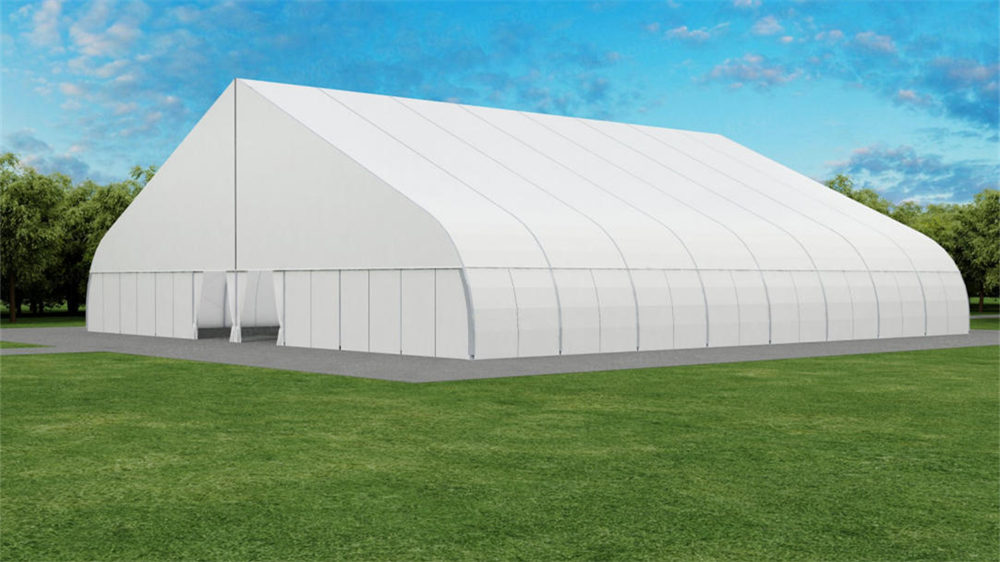
Key Features of KENTEN Arcum Tent for Airport Terminal
KENTEN Arcum Tent is engineered specifically for high-density, time-sensitive aviation environments where stability, speed, and spatial efficiency are critical. Its structural and operational features are designed to align with the real-world behavior of airport passenger flow systems.
1. Large Clear-Span Structural Design
KENTEN Arcum Tent provides wide uninterrupted internal space without central support columns. This allows airports to organize high-density passenger queues, security lines, and boarding preparation zones without spatial obstruction. The clear-span design ensures that movement pathways remain flexible even under peak congestion conditions.
2. Rapid Deployment in Operational Environments
Airport operations cannot be interrupted for infrastructure expansion. KENTEN Arcum Tent is designed for phased installation within active terminals, allowing construction and operation to occur simultaneously. This enables airports to increase capacity without shutting down existing processing areas.
3. Modular Expansion Capability
Each unit can function independently or be combined into larger configurations depending on operational requirements. This modularity allows airports to scale capacity based on real-time demand rather than fixed long-term projections.
4. Flow-Oriented Internal Configuration
The internal spatial design supports flexible passenger movement patterns. Check-in, security, and boarding zones can be reconfigured dynamically to match passenger volume distribution during peak travel periods.
5. Integration with Existing Terminal Infrastructure
KENTEN Arcum Tent is designed to operate alongside permanent airport buildings. It does not require structural modification of existing terminals and can be deployed as an external or adjacent extension depending on site conditions.
Use Cases of KENTEN Arcum Tent in Airport Terminal Operations
KENTEN Arcum Tent is applied in airport environments where passenger flow exceeds the stable processing capacity of existing infrastructure. Its primary function is to support operational continuity during periods of flow concentration.
1. Peak Season Passenger Surge Management
During holiday seasons, international travel peaks, or major regional events, airports often experience sudden increases in passenger volume. KENTEN Arcum Tent can be deployed to expand check-in counters, security screening areas, and waiting zones to prevent congestion collapse.
2. Security and Check-In Overflow Expansion
Security checkpoints and check-in areas are among the first points of congestion in airport terminals. KENTEN Arcum Tent provides additional processing space that allows these functions to be temporarily extended without modifying permanent terminal layouts.
3. Boarding Flow Stabilization
Boarding gates often experience clustering when multiple flights depart within short time windows. KENTEN Arcum Tent can be used to create additional pre-boarding holding areas to stabilize passenger distribution before gate entry.
4. Terminal Renovation or Maintenance Support
During renovation or infrastructure upgrades, parts of airport terminals may become temporarily unavailable. KENTEN Arcum Tent provides alternative processing space that maintains operational continuity during construction phases.
5. Emergency or Disruption Response
In cases of weather disruption, flight delays, or air traffic congestion, passenger accumulation can exceed normal processing capacity. KENTEN Arcum Tent can be rapidly deployed to absorb overflow and maintain safe passenger distribution.
KENTEN Arcum Tent vs Traditional Airport Terminal Expansion
Airport expansion has traditionally relied on permanent architectural construction. However, this approach is increasingly misaligned with modern aviation demand patterns, which are characterized by short-term spikes and unpredictable fluctuations.
| Feature | KENTEN Arcum Tent | Traditional Terminal Expansion |
|---|---|---|
| Expansion Type | Deployable structure | Permanent construction |
| Response Speed | Rapid deployment | Multi-year development cycle |
| Capacity Flexibility | Adjustable in real time | Fixed after construction |
| Operational Disruption | Minimal | High during construction |
| Investment Model | Phased deployment | One-time capital investment |
| Adaptability | High under demand fluctuations | Limited after completion |
Traditional terminal expansion increases capacity permanently, regardless of whether that capacity is consistently needed. In contrast, KENTEN Arcum Tent allows airports to scale capacity only when required, aligning infrastructure more closely with actual operational demand.
Why Airports Need Deployable Infrastructure Instead of Permanent Expansion
The aviation industry is increasingly defined by volatility rather than linear growth. Passenger demand is no longer predictable within long-term stable curves, but instead behaves as a series of irregular spikes influenced by external events, seasonal cycles, and operational disruptions.
Permanent airport expansion is poorly suited to this environment because it locks capacity into fixed structures that may only be fully utilized for limited periods.
KENTEN Arcum Tent introduces an alternative approach by allowing airports to treat capacity as a flexible operational variable. Instead of committing to large-scale construction projects, airports can deploy additional space only when demand exceeds baseline capacity.
This reduces infrastructure inefficiency while increasing responsiveness to real-world operational conditions.
Conclusion
KENTEN Arcum Tent redefines how airport terminal capacity is extended and managed. Instead of relying on permanent architectural expansion, it introduces a deployable structural approach that aligns infrastructure with real-time passenger demand.
In modern aviation environments where passenger flow is increasingly volatile and compression-based, airport performance is no longer determined only by total capacity, but by how effectively that capacity can respond to short-term operational pressure.
KENTEN Arcum Tent enables airports to adapt to these conditions by providing rapidly deployable spatial expansion for critical processing zones.
As a result, airport terminals are no longer static structures defined solely by construction scale. They become operational environments capable of adjusting their functional capacity in response to real-world flow conditions.


