


 2026-02-04
 714
714


Whether you operate a sports academy or manage a commercial sports venue, the challenges are rather similar. Training schedules are disrupted by weather. Facilities sit idle during extreme seasons. Expansion is constrained by long construction timelines and high capital risk. Traditionally, sports academies have prioritized functional reliability, while commercial operators focus on utilization rates and return on investment. However, due to the growing requirement of turnover rate, both are facing the same reality: sports programs and sports businesses can no longer afford seasonal downtime. This convergence has given rise to a new infrastructure logic—all-weather sports tents that operate continuously, adapt flexibly, and support both scheduled training systems and revenue-driven operations. At the center of this shift, KENTEN A-frame Structures come to the surface. The modular tents are not engineered as a temporary shelter, but as a climate-resilient, long-term sports asset.

For decades, outdoor fields and semi-open halls have forced both academies and operators into reactive planning. Classes are canceled, training intensity fluctuates, and revenue windows shrink as weather worsens. An enclosed A-frame sports tent changes this fundamentally. By isolating the interior environment from external conditions, it allows training systems and business operations to run on fixed schedules, not forecasts. The same structure supports both objectives—turning climate control into a strategic advantage.
For sports academies, this means:
Consistent training cycles across the year
Reliable performance evaluation timelines
Better athlete development continuity
For commercial operators, it means:
Stable booking availability
Predictable operating hours
Higher annual utilization rates
KENTEN A-frame Structure is defined by simplicity and efficiency. Its inclined geometry distributes loads naturally, enabling large spans with minimal structural complexity. When executed as a modular aluminum system, A-frame tent delivers:
Column-free interiors for maximum usable area
Clear spatial zoning for courts, training lanes, and circulation
Easy integration of lighting, audiovisual, and mechanical systems
For academies, this supports standardized training layouts. For operators, it allows fast reconfiguration between sports, events, and programs—without structural intervention.
The transition from a weather shelter to an all-season sports facility depends largely on the building facades. Modern KENTEN A-frame Structures can be enclosed using thermally insulated glass walls, solid panels, or hybrid facades combining insulation and controlled daylight. These systems significantly reduce thermal exchange, creating a stable interior environment throughout the year. In practice, the structure performs not as a tent, but as a modular sports building.
For sports academies, this ensures:
Training conditions remain consistent across seasons
Equipment and flooring are protected
Indoor environments support athlete safety and performance
For commercial venues, insulation directly improves:
Energy efficiency
Operating cost predictability
User comfort and retention
Temperature and air quality are no longer secondary considerations in sports facilities—they are performance variables. This stabilizes training quality for academies and enables year-round scheduling, tournaments, and memberships for operators.
Integrated HVAC systems allow A-frame sports structures to maintain:
Stable temperatures for different sports requirements
Continuous air circulation during high-intensity use
Controlled humidity to protect surfaces and equipment
This enables a powerful operational shift: winter training can take place in summer, while summer programs continue uninterrupted during winter months.
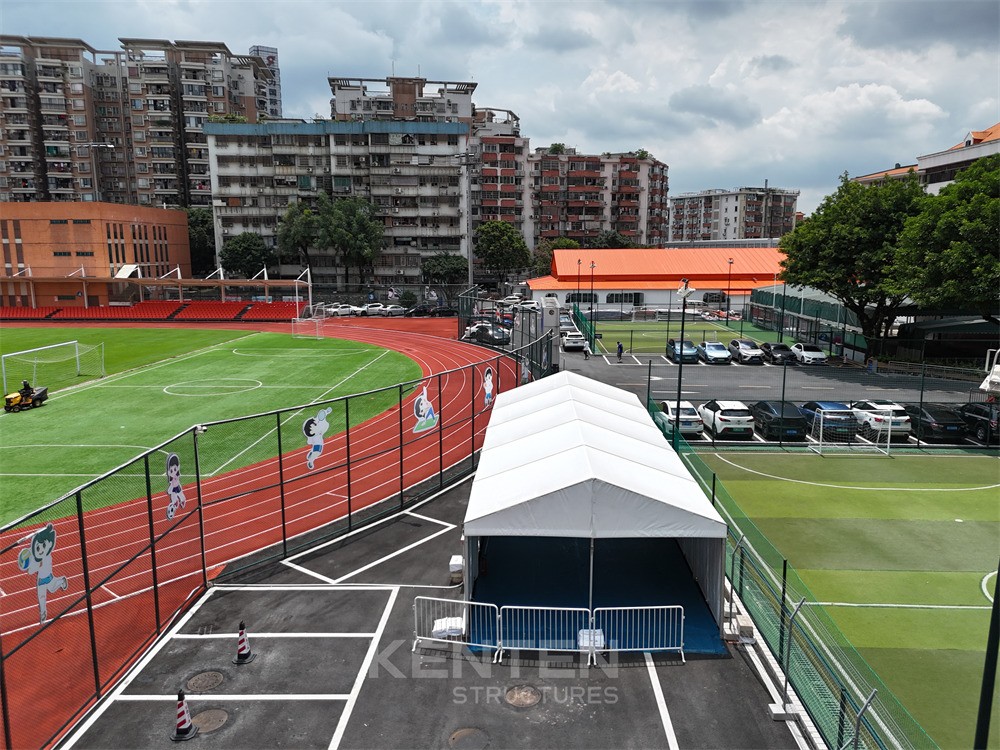
A defining advantage of KENTEN A-frame Structures is their inherent flexibility. Within a single enclosed volume, the same space can support:
Basketball and volleyball courts
Badminton and tennis centers
Soccer(Football) or Rugby(American Football) fields
Padel and pickleball training
Ice-hockey and ice-skating ranks
Swimming pools
Fitness training and physical education classes
Multi-purpose community sports events
Layouts evolve over time through markings, equipment changes, and zoning—not structural alterations. This adaptability allows both academies and operators to respond to shifting demand with minimal downtime.
Speed of Deployment: Aligning with Academic and Market Cycles
Traditional sports halls often require years of planning and construction—out of sync with enrollment cycles, funding windows, or market opportunities. Modular A-frame tents rely on factory-prefabricated components and rapid on-site assembly. Foundations are lighter, site impact is reduced, and delivery schedules are predictable.
For sports academies, this enables:
Installation during academic breaks
Facilities operational by the next term
For commercial operators, it means:
Faster time to market
Reduced construction risk
Earlier revenue generation
While often categorized as temporary, KENTEN A-frame Structures are designed and built for extended service life. For both academies and operators, this flexibility reduces long-term risk and preserves capital—transforming the structure into a mobile, scalable asset rather than a fixed liability. Modular tents are greatly benefited from:
High-strength 6061/T6 aluminum alloy framework
Modular bay lengths enabling scalable layouts
Compatibility with double-layer PVC covers, glass facades, or solid wall systems
Customization with upto 12m for the eave height
Integration of suspended systems
Rapid installation and dismantling schedules
Structural calculations tailored to regional snow and wind loads
Designed with European and America regulation codes
Sustainable sports tents is no longer defined by permanence alone, but by how effectively space is used over time. All-weather KENTEN A-frame Structures contribute to sustainability by:
Reducing material waste through prefabrication
Minimizing permanent land alteration
Supporting energy-efficient operation
Maximizing annual utilization rates
Aligning operational efficiency with environmental responsibility, these tents meet both institutional and commercial sustainability goals.
Conclusion: One Infrastructure, Two Missions
Sports academies and commercial operators may differ in mission, but they share a common need: facilities that work every day, in every season, without locking organizations into inflexible, high-risk construction models. All-weather KENTEN A-frame Structures answer this need by combining:
Architectural clarity
Modular flexibility
Climate resilience
Long-term asset value
They support athlete development and business performance with the same infrastructure—bridging education and commerce through intelligent design. In the future of sports infrastructures, success will belong not to the biggest buildings, but to the most adaptable ones.
Contact KENTEN to customize a fully operational tent in all weathers for your program.


